
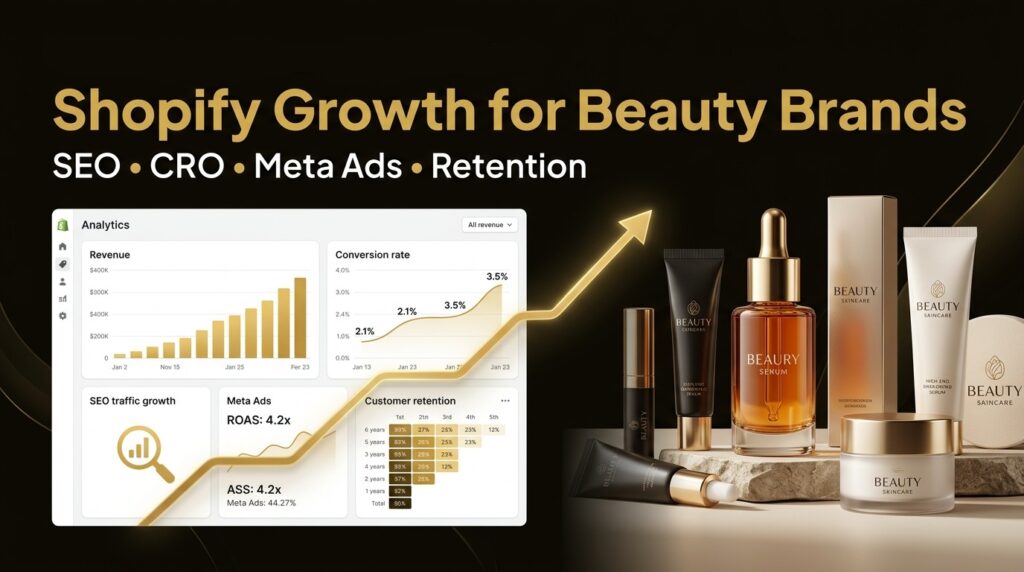
Beauty & Skincare Brands · Shopify Growth Guide
If you run a beauty or skincare brand on Shopify, you already know the category should be converting well. Beauty is one of the highest-converting verticals in e-commerce — and yet most beauty stores still leave a significant share of revenue on the table. This guide breaks down exactly where that revenue goes, and the specific, data-backed fixes that bring it back — for brands selling in the USA, UK, Canada, and UAE.
This isn't a generic "10 tips" listicle. It's the same framework used when auditing real Shopify and WooCommerce beauty stores: store design, conversion optimization, SEO, and Meta Ads, treated as one connected system rather than four separate jobs. If you'd rather skip straight to a personalized breakdown of your own store, you can book a free 30-minute store audit — but the full framework is below if you want to work through it yourself first.
Why Beauty & Skincare Behaves Differently Than Other Shopify Niches
Not every Shopify niche converts the same way, and beauty is genuinely unusual. Unlike high-consideration categories such as furniture or electronics, beauty and skincare purchases are typically lower-priced, repeat, and habit-driven — which is exactly why the category converts so much higher than the Shopify average.
According to Shopify's own 12-month industry data, beauty and personal care averages a 3.46%–4.94% conversion rate, compared to a blended Shopify-wide average of roughly 1.4%–1.8%. Multiple independent benchmark studies across thousands of stores confirm a similar range, generally placing beauty between 2.5% and 4% depending on price tier and traffic quality.
| Metric | Mass-Market Beauty | Prestige / Premium Skincare |
|---|---|---|
| Average conversion rate | 3.0% – 4.0% | 1.8% – 2.8% |
| Average order value (AOV) | $42 – $65 | $75 – $150 |
| Return rate | 5% – 8% | 5% – 8% |
| Repeat purchase rate | 20% – 30% | 30% – 45% |
| Subscription revenue share | 25% – 40% of total revenue (skincare specifically) | |
Sources: Shopify industry benchmark data; aggregated 2026 Shopify CRO studies across beauty-specific store datasets.
The takeaway: beauty has one of the most forgiving conversion environments in e-commerce — which means if your store is underperforming these numbers, it's very likely a fixable structural problem, not a "tough niche" problem.
The 5 Most Common Reasons Beauty Shopify Stores Lose Sales
After auditing beauty and skincare stores across multiple markets, the same five issues show up again and again — often in stores that otherwise look polished.
1. No Ingredient or "Key Actives" Transparency
Beauty buyers research before they buy. If a product page doesn't clearly list key ingredients, concentrations, or what a product is formulated without (sulfate-free, paraben-free, cruelty-free), the buyer simply opens a new tab and checks a competitor's page instead — and often doesn't come back.
2. Reviews Buried Below the Fold
Star ratings and review counts are one of the strongest trust signals in beauty e-commerce, yet they're frequently placed at the bottom of the page instead of directly under the product title, where buyers actually look first.
3. No Skin Type or Concern Matching
"Which one is right for me?" is the single most common hesitation in skincare. Stores without a simple skin-type filter, quiz, or matching guide leave that question unanswered — and an unanswered question at the product page stage almost always means an abandoned cart.
4. Mobile Page Speed Issues
Beauty is a highly visual category, which tempts store owners into loading oversized, unoptimized images. Combined with heavy review and UGC widgets, this regularly pushes mobile load times past 4 seconds — and mobile accounts for the large majority of beauty store traffic. For a deeper breakdown of this specific issue, see the complete Shopify speed optimization guide.
5. No Replenishment or Subscription Path
Skincare and beauty products are, by nature, consumable — yet many stores still sell every product as a single one-time purchase with no subscribe-and-save option. This quietly caps customer lifetime value well below what the category is capable of.
The Beauty Store Conversion Framework
Fixing these issues works best as a connected system rather than five separate tasks. Here is the five-pillar framework used to structure beauty and skincare store growth from the ground up.
- Design & Trust — product page structure built around ingredient transparency and visible proof
- Speed & Mobile UX — sub-3-second load times across image-heavy beauty catalogs
- SEO & Content — ingredient and skin-concern content that compounds organic traffic over time
- Meta Ads — paid acquisition that only scales once the store converts the traffic it already has
- Retention & Subscriptions — turning one-time buyers into repeat, replenishing customers
Pillar 1: Design & Trust — Building a Product Page Beauty Buyers Trust
A beauty product page needs to answer three questions almost instantly: what is this made of, does it work for my skin, and can I trust this brand. Practically, that means structuring the page with an ingredients/key actives section near the top, visible review stars next to the product title (not just at the bottom of the page), and trust badges — cruelty-free, dermatologist-tested, clean beauty certifications — placed where they're actually seen.
Pillar 2: Speed & Mobile UX
Because beauty relies heavily on imagery and user-generated content, speed optimization needs a different approach than a typical Shopify store: lazy-loading for below-fold review widgets, compressed but high-fidelity product imagery, and trimming unnecessary apps that load scripts on every page rather than only where needed.
Pillar 3: SEO & Content for Beauty Brands
Beauty SEO has a distinct advantage most niches don't: people search by ingredient and skin concern, not just by product type. This creates long-tail content opportunities that compound over time. The keyword table below breaks down the types of searches worth targeting.
| Keyword Type | Example | Buyer Intent |
|---|---|---|
| Short-tail / category | "shopify for beauty brands" | Research / brand-discovery |
| Ingredient-led long-tail | "niacinamide benefits for acne" | High-intent, pre-purchase research |
| Concern-based long-tail | "skincare routine for dry skin" | High-intent, routine-building |
| Comparison | "best retinol serum for beginners" | Decision-stage, near-purchase |
| Service / agency intent | "shopify expert for skincare brands" | Brand owner, hiring intent |
Ingredient and concern-based content has compounding value because search demand for specific actives and routines grows steadily year over year, unlike seasonal or trend-driven keywords that spike and fade. For the full technical and on-page SEO process behind this, see the complete Shopify SEO guide for 2026.
Pillar 4: Meta Ads for Beauty Brands
Beauty is naturally suited to Meta's visual ad formats, but ad spend only becomes profitable once the destination page is ready to convert that traffic — sending paid clicks to a product page missing ingredient transparency or visible reviews simply raises acquisition cost without improving results. The full breakdown of campaign structure and budget allocation is covered in the Meta Ads for Shopify guide.
Pillar 5: Retention & Subscriptions
Because skincare and beauty products are consumable, subscription revenue typically makes up 25–40% of total revenue for well-run skincare brands. A simple subscribe-and-save offer on your top 2–3 reorder-ready products, paired with a basic loyalty/points structure, is usually enough to start shifting customer lifetime value meaningfully upward.
Shopify Apps Worth Considering for Beauty Brands
App selection matters in beauty specifically because the category relies on structured data (ingredients, skin types, concerns) that Shopify doesn't support natively. Below is a practical starting list — not every brand needs every app, and stacking too many is itself a common cause of the speed issues mentioned above.
| Function | What to Look For |
|---|---|
| Subscriptions | Flexible delivery frequency, easy skip/cancel, bundle support |
| Loyalty & rewards | Points system, referral loop, VIP tiering |
| Personalization / quiz | Skin-type matching, zero-party data capture, product routing |
| Reviews & UGC | Photo/video reviews, lazy-loaded widget for speed |
| Multi-market selling | Shopify Markets — local currency, duty-inclusive pricing for UK/UAE/Canada |
Because beauty brands frequently sell across borders — the same product line that performs well in the US market often performs comparably well in the UK, UAE, and Canada — Shopify Markets is worth prioritizing early rather than retrofitting later.
What a Full Beauty Store Build Actually Looks Like
When these five pillars are built as one connected system rather than separate tasks, the typical engagement sequence looks like this: brand and product-data foundation first (ingredients, skin-type tagging, certifications), then store structure and product page design, then SEO content built around real search demand, then Meta Ads layered on top once the store is actually ready to convert that paid traffic. Skipping the order — running ads before the product page converts, for example — is the single most common reason ad spend underperforms in this category.
This sequencing is covered in more depth, along with full project scopes, on the portfolio page, and the complete service breakdown — design, SEO, Meta Ads, and CRO — is listed on the services page.
Frequently Asked Questions
What is a good conversion rate for a Shopify beauty or skincare store?
Beauty and personal care is one of the highest-converting categories on Shopify. Industry data places the average conversion rate for beauty stores between 2.5% and 4.9%, well above the all-industry Shopify median of roughly 1.4%. Mass-market and lower-priced beauty brands tend to sit at the higher end of that range, while prestige and premium skincare brands with higher price points typically convert between 1.8% and 2.8%, since higher-priced purchases involve more consideration before checkout.
Should a beauty brand use Shopify or WooCommerce?
Most growing beauty and skincare brands are better served by Shopify because of its built-in subscription infrastructure, app ecosystem for loyalty and personalization, and Shopify Markets for multi-country selling across the USA, UK, Canada, and UAE. WooCommerce can work well for brands already invested in a WordPress content and blog strategy, but it requires more technical setup to match Shopify's native subscription and checkout experience.
How long does it take to grow a beauty brand's traffic with SEO?
Most beauty and skincare brands start seeing measurable organic traffic movement within 60 to 90 days of consistent, ingredient-focused SEO content, with compounding growth typically becoming clear between months four and six. Ingredient and skin-concern searches tend to have lasting search demand, which means well-optimized content continues driving traffic long after it is published.
What should a beauty brand's product page include to convert better?
A high-converting beauty or skincare product page typically includes a clear ingredient or key-actives breakdown, visible star ratings and review count near the top of the page, a how-to-use section, skin type or concern matching, and trust badges such as cruelty-free, dermatologist-tested, or clean beauty certifications. Pages missing ingredient transparency tend to lose buyers to competitors who provide it.
Are Meta Ads still effective for beauty and skincare brands in 2026?
Yes, Meta Ads remain one of the strongest acquisition channels for beauty and skincare brands because the category is highly visual and benefits from influencer-style creative. However, Meta Ads only work profitably when the store's product pages and checkout are already optimized to convert the traffic being paid for — running ads to an underperforming store typically increases acquisition cost without improving overall profitability.
Where to Start With Your Own Beauty Store
If you've read through this and recognize one or two of these gaps in your own store, the fastest next step isn't a full rebuild — it's a clear, honest audit of where your specific store stands against these benchmarks. That's exactly what the free 30-minute strategy call covers: a speed check, an SEO snapshot, and three concrete fixes ranked by likely revenue impact, specific to your store.
Get a Free Audit of Your Beauty or Skincare Store
No pitch, no commitment — just a clear breakdown of what's costing you sales and what to fix first. Only 5 free audit spots available per week.
📞 Book Your Free Strategy CallWant to see how this framework applies to other niches? Read the companion guides for Shopify growth for fashion brands and Shopify growth for home decor brands, or learn more about the strategy behind these guides on the about page.